Back to Versa Controls Portal PranNiti  ·  Respiratory Support System
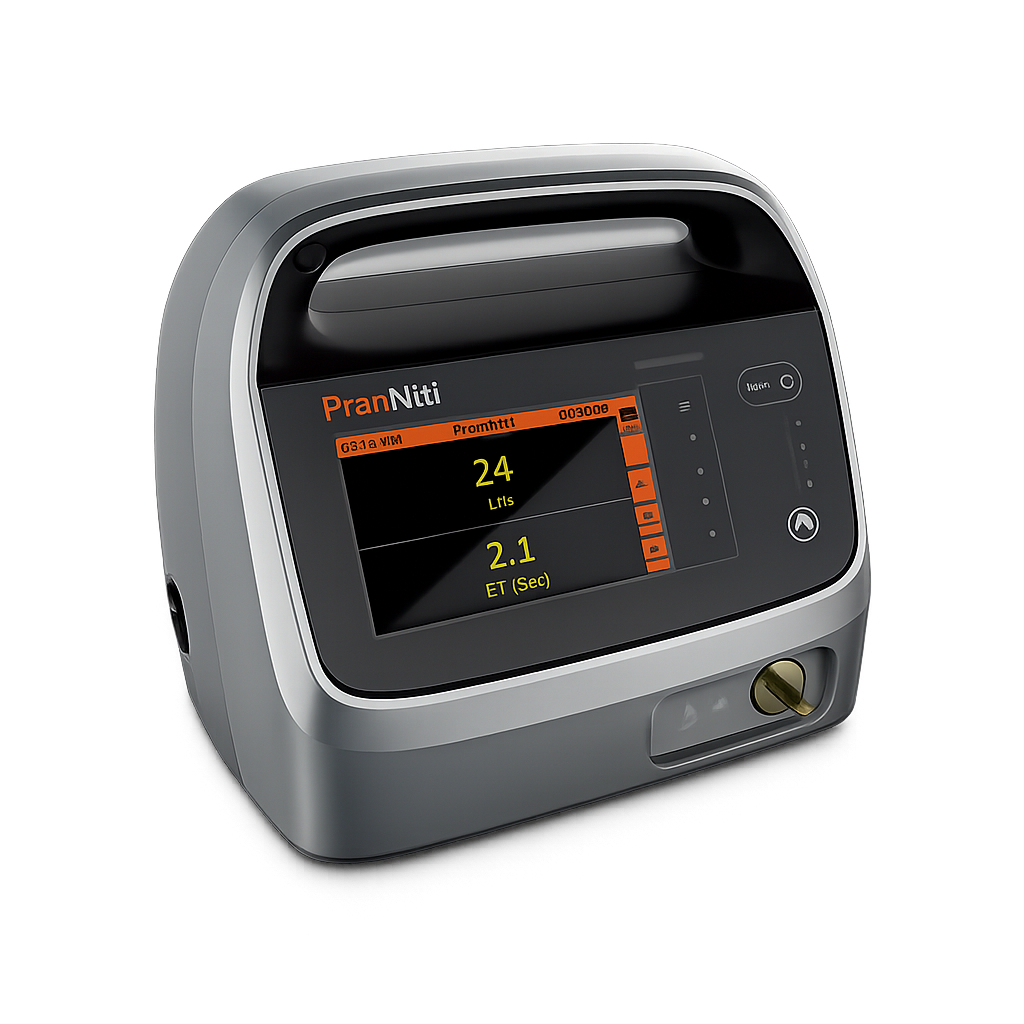
PranNiti Respiratory Support Device

Key Features

  • An enhanced respiratory support system — an innovative modality of non-invasive Oxygen therapy, primarily in mild to moderate Type 1 respiratory failure (requiring less than 15 lit/min of oxygen).
  • Plug and play with existing oxygen supply central or cylinder system using binasal cannula.
  • Improves tissue oxygenation, improves FiO2.
  • First of its kind oxygenation therapy with safety measures.
  • It is not a ventilator and not intended to be used as a life support device.
  • Works on input flows from 0.5 ltr/min to 6 ltr/min.
  • System flushes dead space air and increases inspiratory flow rate to about 3 to 4 times of input flow rate.
Compact Size
User Friendly
60 to 70% Savings
Plug & Play Installation
Built-in Artificial Intelligence

Helps Improve

  • Flushing of anatomical dead space.
  • Enrichment of air with higher concentration of Oxygen (FiO2).
  • Increase in PaO2, resulting in higher diffusion of Oxygen into the blood leading to higher oxygen being delivered to tissue.
  • 60 to 70% savings in oxygen consumption.

Safety Features

  • Dry run alarm — in case of no oxygen input.
  • No inhalation alarm — in case of patient not inhaling.
  • Features to prevent barotrauma.
  • Device bypasses the system to deliver inflow oxygen to the patient in case of power failure.

1st A device for Oxygenation Therapy with Safety Measures  |  Patented in India  |  International Patent Filed  |  Not used as ventilator or life support device.

Data Points

Comparative performance data demonstrating PranNiti's low-flow input with high inspiratory flow output across clinical modalities.

Operating Range of PranNiti

Low flow to High flow operating range (example only — actual ranges may differ)
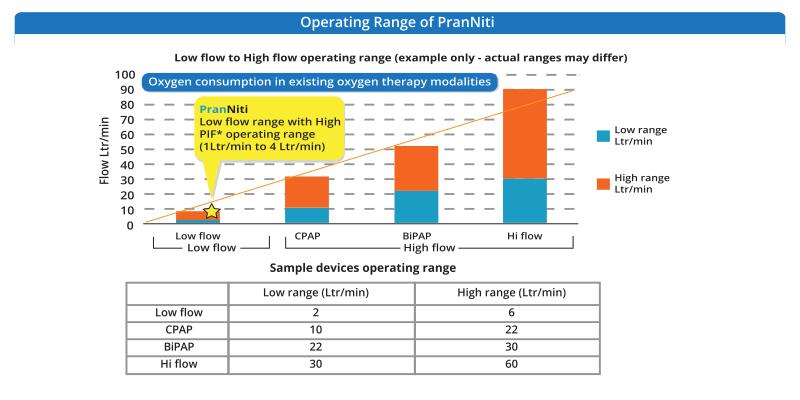
Oxygen consumption chart — Operating range of PranNiti vs Low flow, CPAP, BiPAP and Hi flow

PranNiti: Low flow range with High PIF* operating range (1 Ltr/min to 4 Ltr/min)

Sample devices operating range
Modality Low (Ltr/min) High (Ltr/min)
Low flow26
CPAP1022
BiPAP2230
Hi flow3060

How is PranNiti different than HFNO

HFNO# VS PranNiti — achieving the same inspiratory flow with significantly lower input
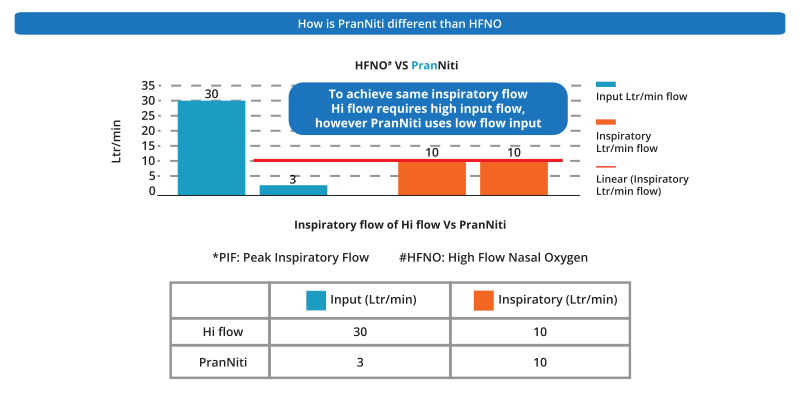
Comparison chart — HFNO vs PranNiti input and inspiratory flow

To achieve same inspiratory flow, Hi flow requires high input flow — however PranNiti uses low flow input.

Device Input (Ltr/min) Inspiratory (Ltr/min)
Hi flow3010
PranNiti310

*PIF: Peak Inspiratory Flow  |  #HFNO: High Flow Nasal Oxygen

Delivery Flow of PranNiti

Input flow Vs Output flow — exponential output compared to conventional linear flow
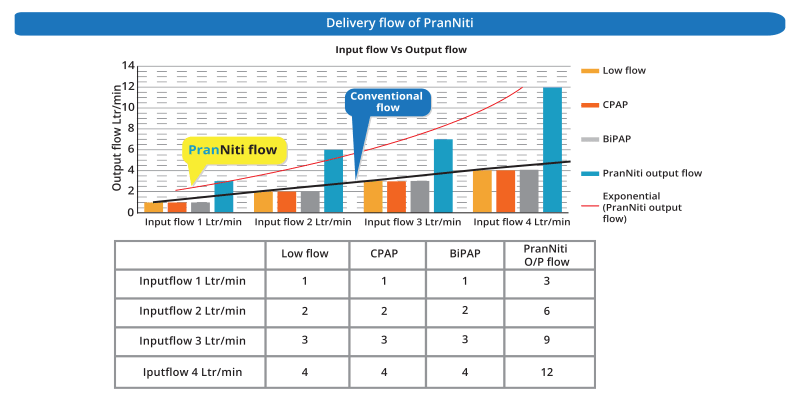
Delivery flow chart — PranNiti output flow vs conventional modalities
Input flow Low flow CPAP BiPAP PranNiti O/P
1 Ltr/min1113
2 Ltr/min2226
3 Ltr/min3339
4 Ltr/min44412

Type-1 Respiratory Failure — Enhanced PIFR Heat Map

New modality to support Type-1 Respiratory failure through Enhanced PIFR (Peak Inspiratory Flow Rate)

Specialist Condition / Scenario Details / Indications
Intensivist / Anaesthetist Shock Septic, Pneumonia, Viral, Bacterial, Haemorrhagic, Anaphylaxis
Surgeon / Intensivist / Anaesthetist Post Operative Cancer, Cardiac, Neuro, Any major Surgeries
Intensivist / Anaesthetist Weaning from respiratory failure Weaning from Ventilator / HFNO
Intensivist / Cardiologist Cardiogenic Shock LVF / Acute MI, Cath Lab Procedures
Physician / Chest Physician Acute Respiratory failure Pulmonary edema, Mild to moderate respiratory failures due to various causes
Trauma Units / Centers Respiratory insufficiency To support respiratory system
Physician / Chest Physician / Pulmonologists Chronic lung diseases Chronic lung diseases, Interstitial fibrosis, COPD, Post COVID lung fibrosis requiring oxygen
Surgeon / Physician / Anaesthetist Pre operative preparation and Post OP Bariatric, Chronic lungs disease patients
Anaesthetist Intra operative Supportive of Oxygen therapy during high risk procedures under LA or regional anaesthesia procedures
Anaesthetist Diagnostic procedures Oxygen Support during Bronchoscopy, Gastroscopy, MRI, etc.